
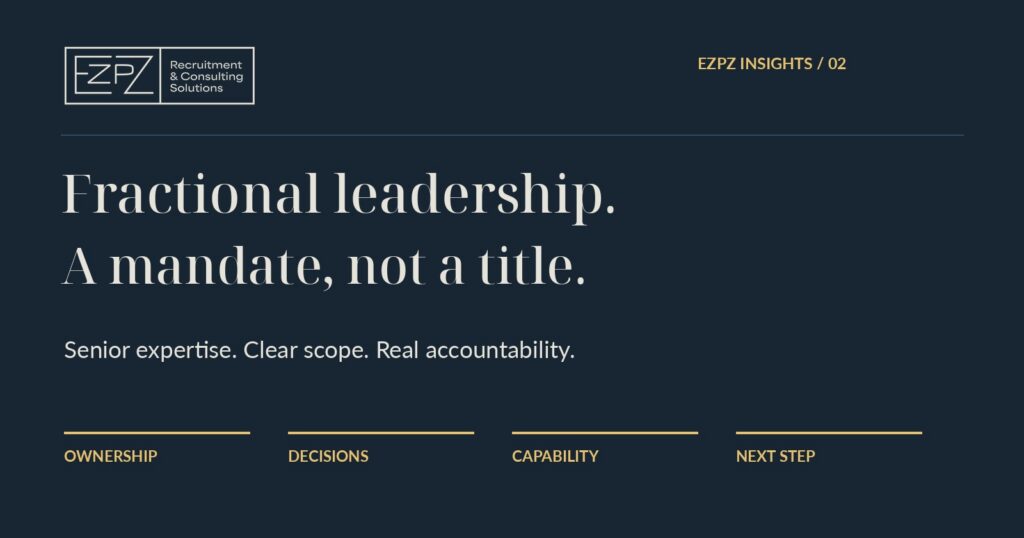
An organization can need executive leadership before it is ready to make a permanent executive hire. Treating those as the same decision can create unnecessary pressure.
Perhaps a critical function needs direction now, but the long-term role is still unclear. Perhaps an existing manager needs experienced support through a change. Perhaps the business knows it has a delivery problem but has not yet separated leadership gaps from capacity, priorities, and structure.
Fractional leadership offers one possible response: bring in senior capability for a defined portion of time, with a clear mandate and real accountability. It should not mean buying an impressive title and hoping clarity follows.
EZPZ founder Jon Paquette recommends this approach when senior-level direction and execution are needed now, but a permanent executive appointment is premature, too slow for the immediate need, or unnecessarily risky. The engagement can serve as a practical bridge while the business stabilizes the function and makes a better-informed long-term decision.
The word “can” matters. A fractional arrangement is a staffing model, not an outcome. Its value depends on the work, the leader, the authority granted, and the organization receiving the support.
The right starting question is not “Which fractional executive should we hire?” It is “What needs to change, and what leadership commitment will that change require?”
Define fractional leadership before buying it
Fractional leadership is part-time senior leadership with an agreed scope of responsibility. The executive contributes to decisions and execution within that scope, while their availability and accountability are explicitly defined. The arrangement may support an ongoing need or a transition, but the commitment should match the actual work rather than a label.
In Harvard Business Review’s discussion of the model, Tomoko Yokoi and Amy Bonsall describe senior leaders serving organizations for a fraction of their time. Their guidance emphasizes defining the work to be done and treating the leader as part of the leadership team rather than an outside source of occasional advice (HBR, “How to Make Fractional Leadership Work”).
At EZPZ, we would distinguish the operating need before choosing the engagement. Does the client need advice, hands-on leadership, extra execution capacity, or continuous coverage of a vacant position? Those needs can overlap, but they should not be blurred.
A consultant may deliver a recommendation or defined project. A fractional leader may hold ongoing decision responsibilities within an agreed remit. A temporary full-time leadership gap may require a more intensive interim arrangement. The practical boundaries belong in the scope, not in assumptions about what those labels always mean.
Be especially careful about availability. Part-time senior expertise cannot quietly become an expectation of unlimited full-time coverage.
Use it when the mandate needs clarity, not just a name
Hiring a permanent executive into an undefined problem can leave both sides disappointed. The organization expects transformation; the candidate arrives to find conflicting priorities and uncertain authority.
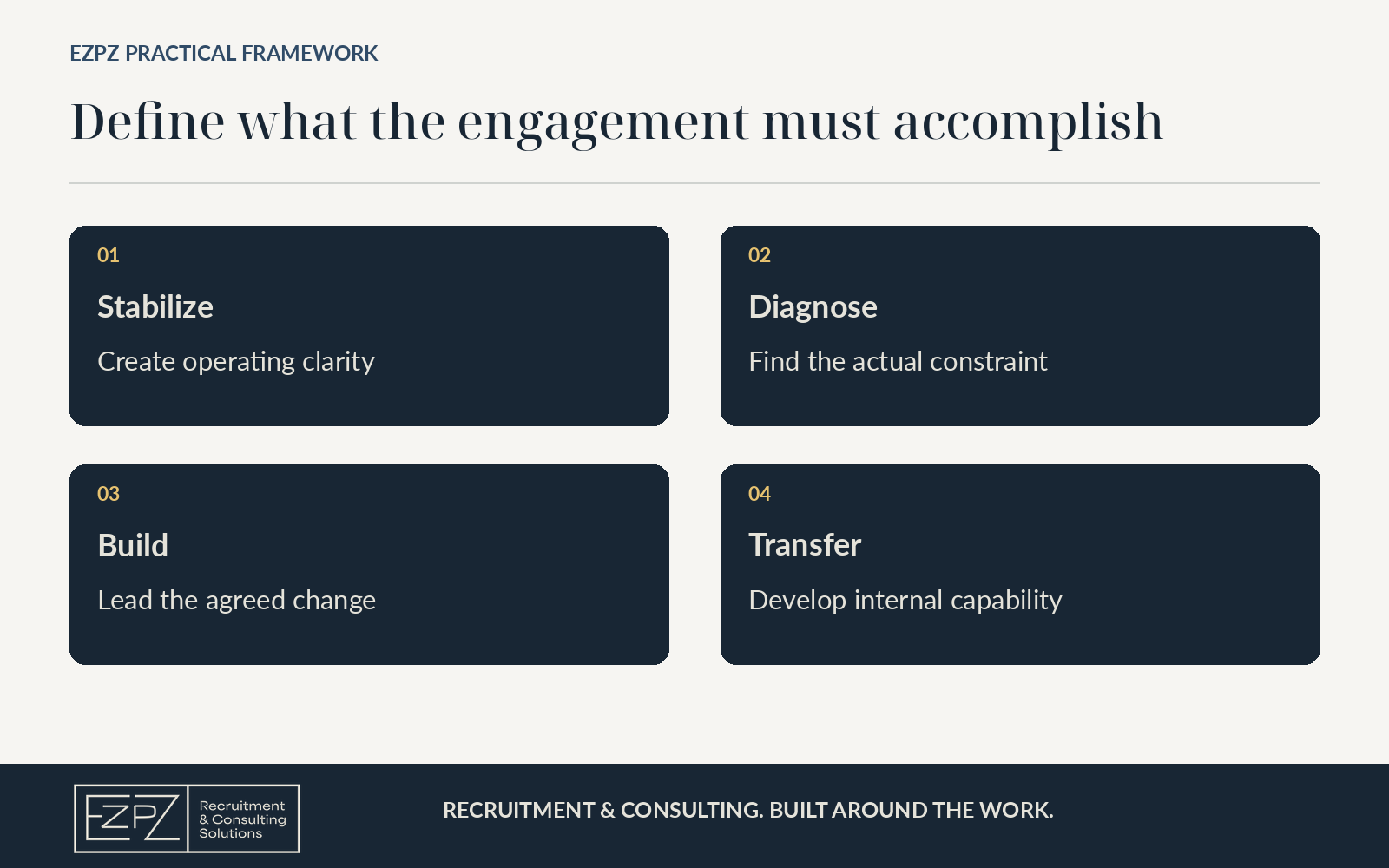
Jon’s view is that fractional leadership can help a client stabilize, diagnose, build, and guide a function while the long-term decision becomes clearer. That is a proposed purpose for the engagement, not a promise that every business needs the model.
Consider an illustrative company whose project delivery has become unpredictable. Leaders disagree about whether the answer is a new head of operations, a stronger project-management function, different systems, or more staff. Advertising a broad executive role may commit the company to one answer before it understands the problem.
A defined leadership engagement could examine the work, establish a delivery review, clarify ownership, and identify where decisions are breaking down. The eventual recommendation might be a permanent executive, a different management structure, development of an existing manager, or additional specialist capacity.
That openness is a strength. The engagement should not have to justify itself by recommending a bigger version of the same role.
Before starting, specify which decisions the organization expects to make at the end. If nobody can name the uncertainty the leader is meant to resolve, the scope is not yet ready.
Stabilize the function without confusing activity with control
A calendar full of new meetings is not the same as a stable function. The first objective should be a usable operating structure: priorities, owners, a review rhythm, and an agreed way to escalate problems.
Our recommendation is to identify the few commitments the business cannot afford to lose sight of. Which deliverables are at risk? Which customers or internal teams depend on them? Which decisions are waiting because authority is unclear?
The leader should then establish visibility that supports action. A short, current view of priority work can be more useful than a complicated dashboard with no accountable owner. The business needs to know what is progressing, what is blocked, and who can change the situation.
This is consistent with HBR’s practitioner guidance to agree on two or three key priorities and review them with the chief executive regularly. The discussion emphasizes communication and accountability rather than simply adding executive capacity (HBR).
For an illustrative delivery function, stabilization might mean assigning clear ownership to critical projects and creating an escalation path for unresolved dependencies. It should not mean promising that every project will recover on a predetermined timetable.
The scope must distinguish what the fractional leader can control from what requires a sponsor, additional staff, budget, or a broader organizational decision.
Diagnose the constraint before prescribing the organization chart
A performance problem is not automatically a headcount problem. It may reflect unclear priorities, weak handoffs, a capability gap, incompatible incentives, stakeholder conflict, or a structure that no longer fits the work.
Jon specifically includes diagnosis among the expected outcomes of a fractional engagement. The leader should help determine what is preventing performance rather than assume the answer is already contained in the job title.
Our recommendation is to examine a few representative pieces of work from request to delivery. Where does information disappear? Where does ownership change? Which approvals matter, and which simply repeat earlier decisions? Where are capable people waiting on something they cannot resolve?
Keep observations separate from conclusions. “Three projects are waiting for the same decision” is an observation. “We need a new vice president” is a possible response that still needs support.
Include the managers who live with the process. A leader who interviews only the executive sponsor may miss the practical constraints, while a leader who listens only to the team may miss commercial or governance requirements.
The deliverable should be a diagnosis that the organization can act on: the major constraints, evidence supporting them, choices available, and trade-offs. It should be specific enough that another leader could understand why a recommendation was made after the engagement ends.
Write a mandate with outcomes, boundaries, and decision rights
A fractional leader cannot be accountable for an outcome while everyone else retains an unlimited right to change the priorities. Clear authority is part of the engagement, not an administrative detail.
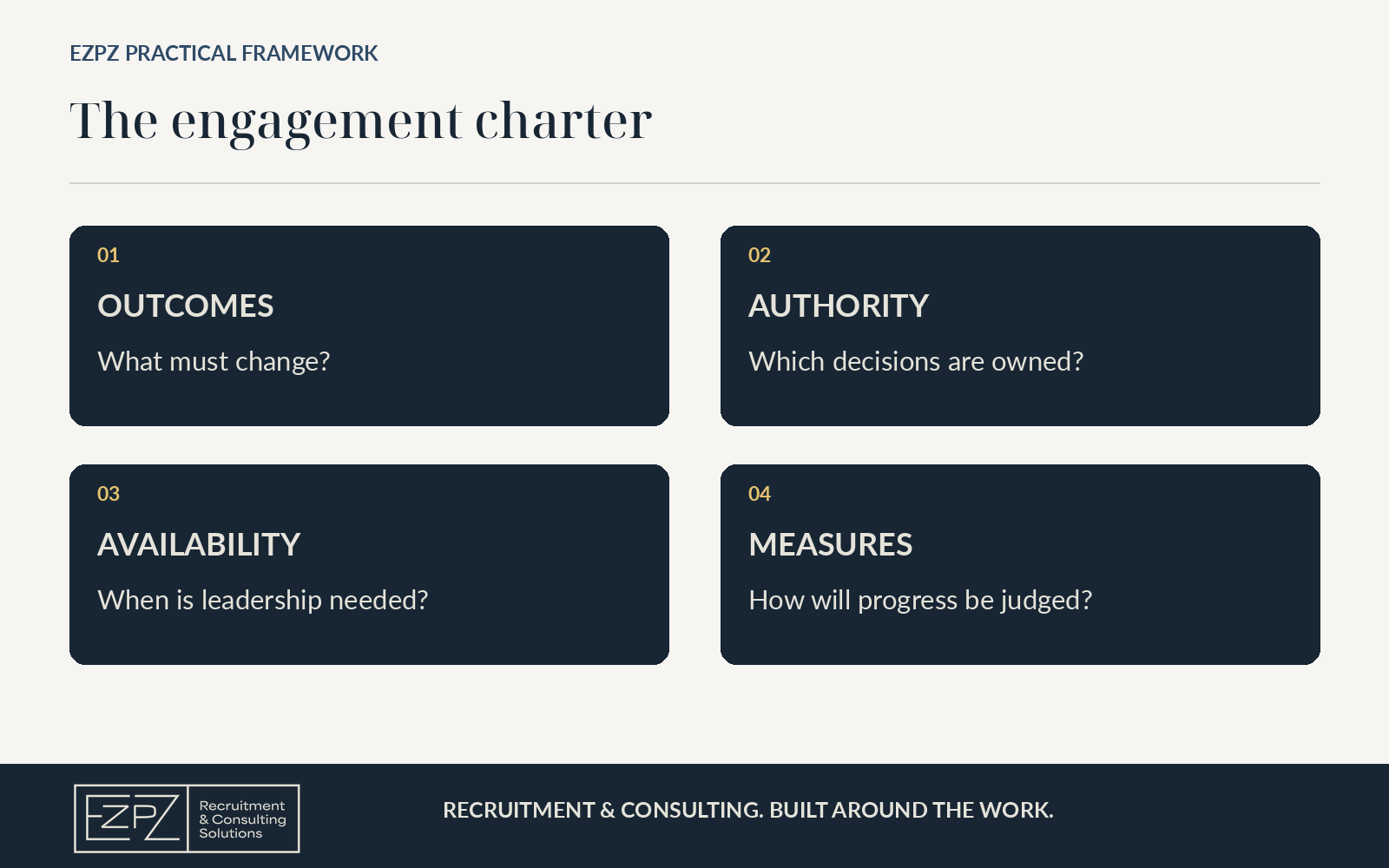
Our recommended mandate includes the business problem, intended outcomes, decisions the leader may make, decisions requiring approval, available resources, and the measures that will indicate progress. It should also state what is outside scope.
For example, “improve operations” is too broad. An illustrative, more useful mandate might be to establish a reliable delivery review, clarify ownership across a set of projects, and recommend a future management structure. The company would then agree on the specific evidence that demonstrates each deliverable is complete.
Define the sponsor’s responsibilities as well. Who resolves disagreement between functions? Who approves spending? Who communicates the leader’s authority to the team? Who makes the final decision if a recommendation changes existing roles?
HBR’s discussion warns that scope can expand and recommends repeated conversations about whether the agreed priorities remain right. It also stresses giving the leader the context and access needed to operate effectively (HBR).
A good mandate therefore allows deliberate change without normalizing uncontrolled expansion. When the business adds a major responsibility, revisit the capacity, timeline, and trade-offs instead of assuming the original arrangement can absorb it.
Match the leader to the setting, not just the function
A successful executive from one setting is not automatically the right fractional leader for another. The company is buying relevant judgment and the ability to operate within its actual constraints, not a résumé trophy.
Jon’s broader hiring standard applies here: assess comparable scope, complexity, ownership, and environment. A person who directed a large department with substantial support may or may not be prepared to work hands-on in a smaller business.
Ask the candidate to explain a relevant situation. What did they diagnose? What did they personally change? How did they build agreement? What remained in place after their involvement ended?
Then explore the delivery model. How will they stay informed between scheduled working periods? Which decisions require their presence? How do they handle competing commitments? What happens when an urgent issue occurs outside the agreed cadence?
Yokoi and Bonsall recommend considering both strategic and hands-on capability, how the person works fractionally, and how they handle context switching. They also discuss the risk of applying a familiar solution without adapting it to the organization (HBR).
The selection conversation should reveal how the executive would approach this company. A confident presentation about what worked elsewhere is not enough without curiosity about the current mandate.
Give existing managers a stronger system, not a new dependency
One test of the engagement is what remains when the leader’s time decreases. If the organization cannot run the new process without that individual, the transition plan needs attention.
Jon includes supporting and developing existing managers among the expected outcomes. The purpose is to retain capability in the business rather than rent judgment indefinitely.
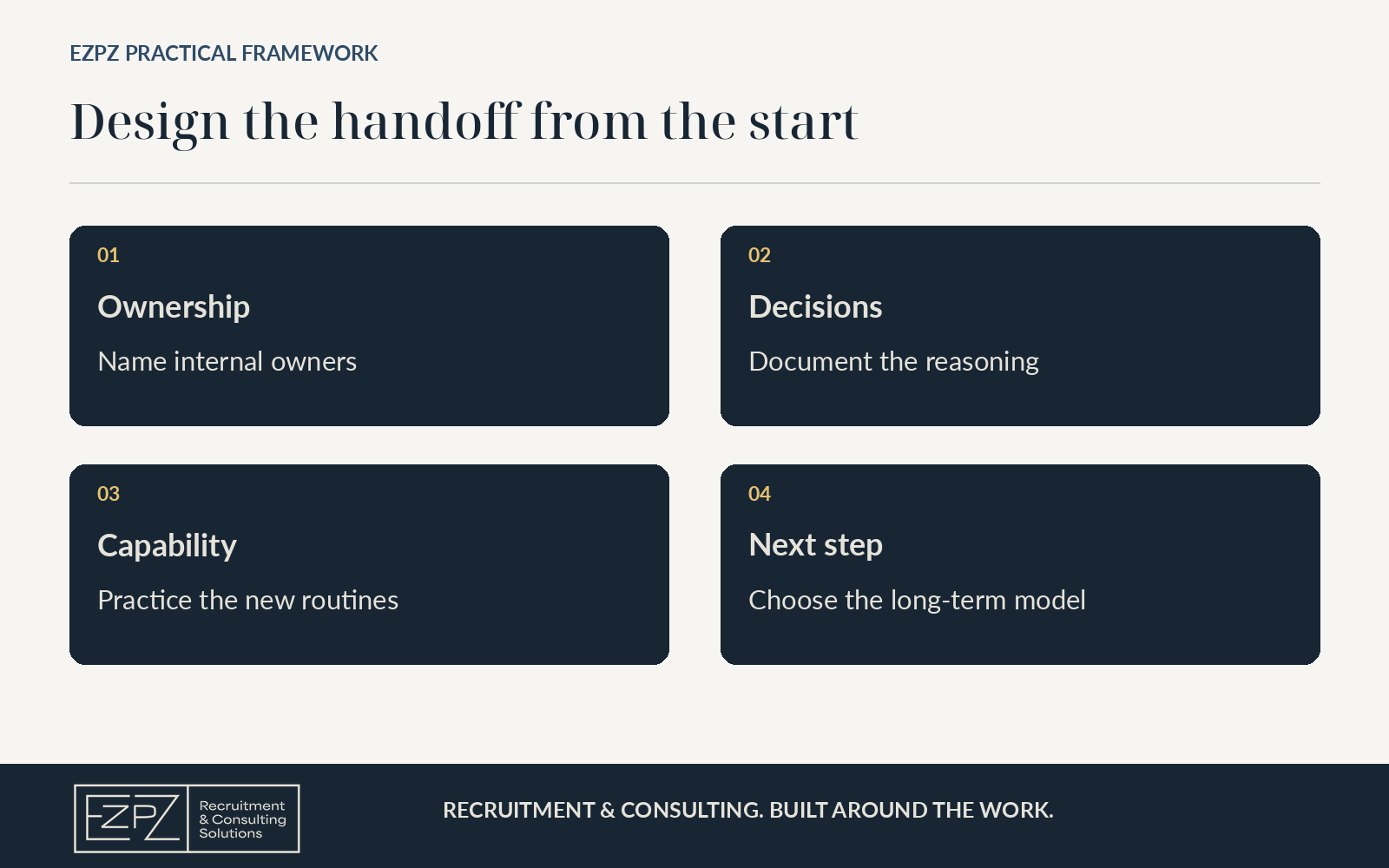
Our recommendation is to pair each major process improvement with a named internal owner. If the fractional leader creates a planning rhythm, someone should learn how to maintain it. If they redesign an escalation process, managers should understand when and how to use it. If they introduce a decision framework, teams should practice applying it to real work.
Knowledge transfer should happen during execution, not only in a final handover presentation. Explain the reasoning behind priorities, involve managers in difficult decisions, and document the assumptions that could require a future change.
This does not mean the leader avoids taking responsibility. It means responsibility includes preparing others to operate well after the immediate engagement.
For an illustrative growing function, the best result might be an existing manager who can now lead effectively with a clearer mandate and better support. A permanent executive hire may still be appropriate, but it should not be treated as the only possible successful outcome.
Decide how progress will be judged
Meeting attendance, hours billed, and presentations delivered are easy to count. They do not by themselves show that the business is better led.
Begin with measures tied to the mandate. If the problem is delivery control, look at whether work has accountable owners, whether risks are surfaced in time, and whether decisions are being made through the agreed process. If the problem is organizational design, look at whether responsibilities and handoffs are clear enough to use.
Some outcomes will be measurable quickly. Others, such as leadership development or a structural change, will require a longer view. Separate leading indicators from business results and avoid attributing every movement in performance to one person.
Our recommendation is to define a baseline before declaring improvement. A metric has limited value if nobody agrees on what it measures, how it is collected, or what else affects it.
Use reviews to make decisions rather than produce ceremony. What has changed? Which assumptions proved wrong? What remains blocked? Does the original mandate still fit?
If the work has expanded into a continuous executive responsibility, acknowledge that. The review may indicate that the business now needs a full-time leader, a more intensive interim commitment, or a different specialist. A sensible engagement makes that choice clearer rather than protecting its own continuation.
Build the permanent role from what the business learns
A fractional engagement can make a later permanent search more precise, but only if the learning is captured. Otherwise the company can finish the engagement and return to the same vague job description.
Jon identifies future-state organization design as a useful outcome: roles, reporting relationships, capability needs, hiring priorities, and the specification for a permanent leader where appropriate. He also includes realistic market and talent insight around scope, availability, compensation, and timing.
Use the engagement to distinguish leadership work that will remain from transition work that will end. A permanent role should not automatically inherit every task that accumulated during a difficult period.
The same logic underpins sound role analysis. OPM’s guidance connects tasks and competencies before selection decisions are made, rather than assuming a title defines the required capability (OPM job analysis).
For the client, the practical output is a clearer hiring brief: the outcomes the permanent leader owns, the environment they will enter, the authority available, and the evidence a candidate should bring.
That brief can support a more focused search. It also gives candidates a more honest account of the opportunity, including what has already been stabilized and what still requires significant work.
Recognize when fractional is the wrong answer
The model should not be used to disguise a full-time problem as a part-time budget. If the work requires continuous availability, frequent direct supervision, or an intensity the proposed engagement cannot supply, choose a different arrangement.
Our recommendation is also to pause when the organization will not grant the access or authority necessary for the work. An executive cannot diagnose a function while being denied its information, and cannot lead a change if the sponsor refuses to resolve conflicts about its scope.
Another warning sign is an engagement defined entirely by an impressive title. “We need a fractional COO” may be true, but the statement does not establish whether the problem is leadership, execution capacity, systems, or a combination.
Finally, be careful when the company wants an external leader to deliver difficult messages that its own executives will not support. The sponsor still owns the business decision. Bringing in a specialist does not transfer that responsibility.
These are not arguments against fractional leadership. They are reasons to match the model to the need honestly.
At EZPZ, recommending the wrong arrangement would undermine the purpose of a consultative partnership. The useful conversation is about what will work for the client, including when a permanent hire or another form of support is more appropriate.
Buy clarity and accountability, not simply access to a title
Fractional leadership is most useful as a deliberate response to a defined need. The business should know what the leader is there to stabilize, diagnose, build, or guide, and how the relationship will be reviewed.
The starting point is a mandate. The operating requirement is meaningful access and authority. The lasting value should include stronger internal capability and a clearer view of the next leadership decision.
That is the approach Jon describes: bring senior direction and execution into the business without rushing a permanent appointment before its true requirements are understood.
For a business facing an immediate leadership gap, the next step is not necessarily a job advertisement. It may be a conversation about the problem, the urgency, and the commitment required to address it.
EZPZ can help frame that discussion, assess the leadership need, and determine whether a fractional engagement or a permanent search better fits the situation. The objective is not to sell a particular staffing label. It is to help the organization make a leadership decision it can explain and support.