
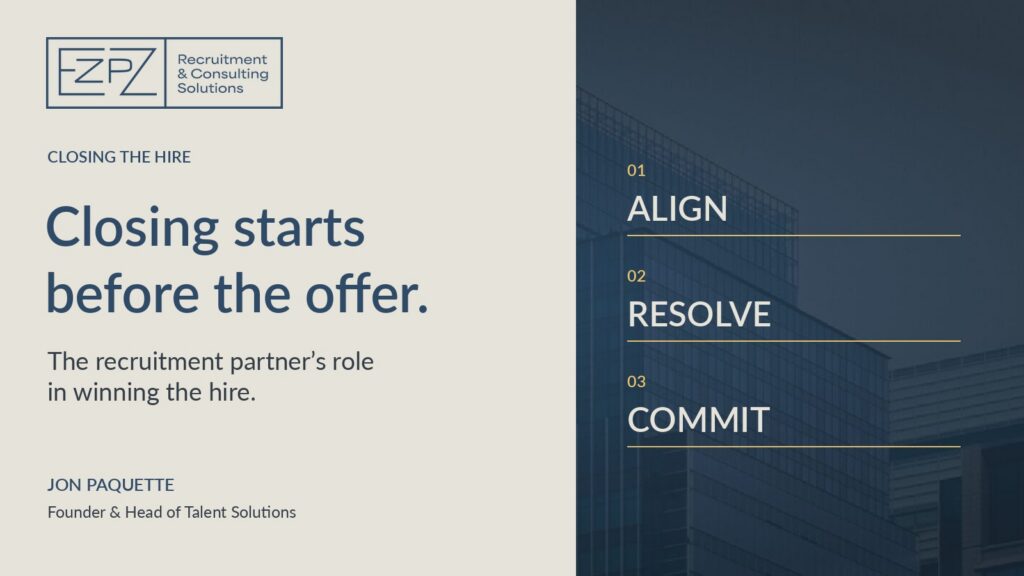
A signed offer is not the beginning of a successful close. It should be the result of work that started long before anyone drafted the letter.
At EZPZ Recruitment & Consulting Solutions, I see closing as a recruitment partner’s responsibility throughout the hiring process. It means understanding what the candidate needs, what the client can genuinely offer, and what could prevent a well-matched person from accepting and starting with confidence. It does not mean waiting until the final interview and then finding a more persuasive way to ask for a yes.
That distinction matters because enthusiasm and alignment are not the same thing. A candidate can enjoy the conversations, respect the company, and remain uncertain about whether the move makes sense. A hiring manager can want that candidate while lacking agreement internally on compensation, work arrangement, or the authority the role will carry.
My job is to make those uncertainties visible early enough to address them honestly. I focus on three concerns: offer-value alignment, conviction that this is the right career move, and the decision or execution risks that could derail acceptance or the start.
The goal is not an acceptance at any cost. It is an informed commitment that both sides can stand behind when the excitement of the offer call has passed.
Closing starts before the offer, not with a sales pitch
I do not consider a candidate “closed” because they have repeated a salary target or said the opportunity sounds exciting. Those are useful signals, but they do not explain the conditions under which the person would actually change jobs.
There is a difference between knowing what someone likes and understanding what they need to decide. The second requires follow-up: what is still unclear, which trade-offs are acceptable, and what would make staying put the better choice?
The employer’s side needs the same attention. Before describing an opportunity as flexible, I need to understand what flexibility means and who can approve it. Before discussing growth, I need to know whether the company can explain a realistic path rather than a hopeful possibility.
Gallup’s 2025 U.S. employee findings illustrate why the conversation cannot stop at salary: 60% rated greater work-life balance and personal wellbeing as very important when considering a different job, compared with 57% for stability and job security, 53% for better income or benefits, and 48% for the opportunity to do what they do best. Those figures describe stated job-choice priorities, not offer-acceptance rates or results achieved by a recruiter. (Gallup)
I use that broader perspective as a reason to ask better questions, not as a substitute for learning what matters to the individual in front of me. The candidate’s own words should guide the discussion.
Offer-value alignment: understand the entire decision
Compensation is not merely a base-salary question. I want to understand how the candidate evaluates the complete opportunity: incentive compensation, benefits, paid time off, title, flexibility, travel, commute, relocation, and start date.
That does not mean collecting personal information for its own sake. It means clarifying what the proposed job must provide and what practical requirements the person needs it to meet.
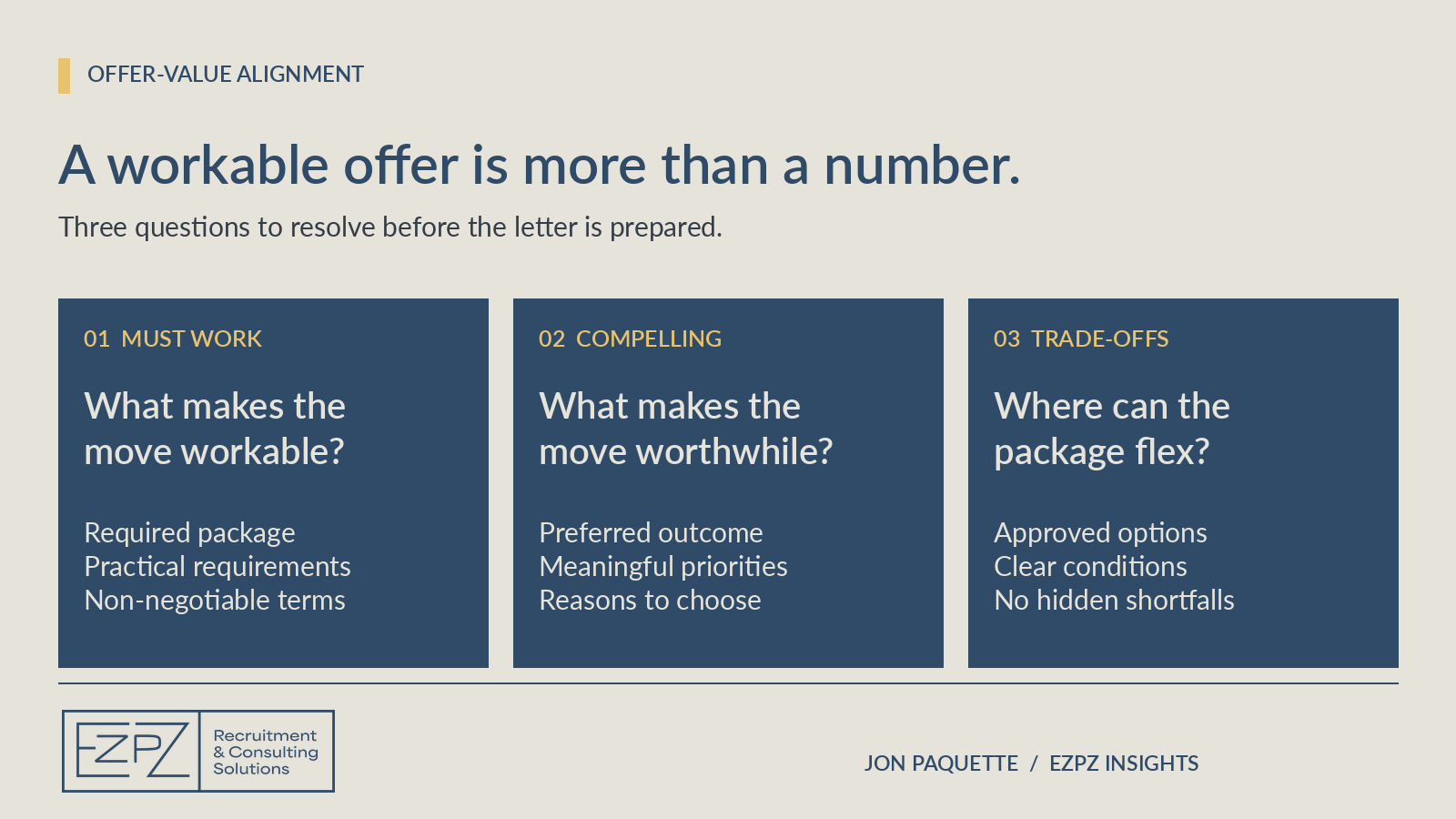
I separate three forward-looking questions that are easy to blur together. What is the minimum complete outcome that would make the move workable? What is the preferred outcome? Which elements could reasonably offset a gap elsewhere?
The minimum is not a number to extract and use as bargaining leverage. It is a boundary to respect. The preferred outcome helps establish what would make the opportunity compelling, while the tradeable elements show where a solution may exist.
For example, a later start date may matter more than an earlier offer call. A clear work arrangement may be more useful than a title change. An incentive opportunity should be explained differently from guaranteed compensation, not presented as though both carry the same certainty.
These are decision factors to examine, not promises that every employer can accommodate them. I want the candidate to understand the package as it actually exists, and the client to understand which unresolved terms could prevent acceptance.
The practical question is straightforward: “What must the complete package look like for a move to make sense?” That is a better starting point than assuming the largest base salary will settle every other concern.
Resolve the package before producing the letter
Before an offer is prepared, I give the client a candid assessment of the required outcome, desired outcome, strongest noncash priorities, and likely negotiating points. Where the candidate has shared competing terms they want considered, those belong in the discussion too.
Then I identify the client’s actual room to move. That may involve base salary, a sign-on payment, incentive structure, paid time off, work location, travel, or timing. An agreed future compensation review is not the same as a guaranteed increase, and I would not describe it as one.
The objective is not automatically to increase cash. It is to solve the issue that matters most within terms, precedent, and approvals the client can support.
This is also where internal coordination belongs. If finance must approve an exception, HR must confirm a policy, or the hiring manager must clarify the role’s scope, those decisions need an owner before the offer is presented. A recruiter cannot responsibly negotiate with flexibility that the company has not authorized.
My verbal pre-close is conditional and specific: “If the role, reporting relationship, and package land as we have discussed, what, if anything, would keep you from accepting?”
The answer is an invitation to uncover unfinished work, not a promise to hold over the candidate later. Once the terms are clear, I can explain the full package side by side, confirm understanding, and address remaining questions without disguising a shortfall.
Career-move conviction: enthusiasm is not enough
The candidate I pay close attention to is the one who remains politely enthusiastic but cannot clearly explain why this opportunity is better than staying. That does not make the person uncommitted. It means the decision may not yet be understood.
I want to know whether the role addresses the original reasons for considering a change. If the candidate wants better leadership, more interesting work, clearer advancement, or a more workable schedule, a higher number alone may leave the central issue untouched.
I organize that discussion around four areas:
- Work: Does the candidate understand the actual mandate, priorities, resources, pressures, and measures of success?
- Growth: What could the person learn, own, and become qualified to do over the next 12–24 months, without treating possibilities as guarantees?
- People: Have they had enough meaningful interaction with the manager and team to assess how they would work together?
- Enterprise: Have their questions about the company’s direction, stability, and purpose been answered credibly?
A vague statement about “culture fit” does not settle those questions. I want to understand observable conditions: how decisions are made, how feedback works, how much autonomy the role carries, and what happens when priorities conflict.
The U.S. Office of Personnel Management describes realistic job previews as a way to communicate both positive and negative aspects of a job so applicants can assess the match; it recommends providing that information before an offer and treats it as candidate self-evaluation rather than a traditional selection test. (OPM)
That is consistent with the standard I want to apply: make the opportunity understandable, not merely attractive.
Turn uncertainty into a specific conversation
When a candidate raises a concern, I try to turn it into a request for evidence or clarification. Repeating the selling points more enthusiastically is not a substitute for answering the question.
If advancement is uncertain, the client can explain what greater responsibility could look like, what milestones would matter, and whether comparable progression has actually occurred. If the manager relationship is the concern, a focused conversation can cover working style, feedback, priorities, and the first 90 days.
If stability is the issue, an appropriate leader may be able to explain why the role exists and how it supports the business, within the limits of what the company can share. The recruiter should not fill gaps with invented assurances.
My comparative test is direct: “If the compensation were equal, would you choose this job over staying and over your other options? Why?”
A hesitant answer helps identify what is missing. The next step may be a discussion with the manager, better information about the work, or an honest acknowledgment that the opportunity does not address the candidate’s priorities.
The candidate does not need to agree with every feature of the role. They need a realistic understanding of the trade-offs and a genuine reason to choose them. I would rather uncover a fundamental mismatch before the offer than call it a negotiating problem afterward.
Decision and execution risk: a yes still needs a workable path
A candidate may prefer the opportunity and still face obstacles to accepting or starting. I therefore want a clear picture of the relevant timing, competing processes, resignation concerns, notice obligations, and start-date requirements.
The purpose is not to monitor the person’s private life or demand exclusivity. It is to understand what could affect a decision and coordinate the steps that both sides can control.
I ask where other interview processes stand, what decision deadlines are real, and whether those dates have changed. If another employer expects an answer on Friday, the client needs that information before planning a debrief for the following week.
I also ask how the candidate expects the current employer to respond to a resignation. A counteroffer is a possibility to discuss, not a reason to frighten someone into an immediate commitment.
Useful questions include: “What might your employer offer you?” “Which part would be hardest to turn down?” and “If the money changed but the work and manager stayed the same, what would you want to do?”
Those questions bring the decision back to the candidate’s original reasons for exploring. I do not need an unsupported statistic about how often counteroffers fail to have that conversation. I need an honest comparison of what would change, what would remain unresolved, and what evidence would make a new promise credible.
Support the decision without crossing personal boundaries
Career decisions can have practical effects beyond the individual. My approach is to give the candidate accurate information, room to evaluate it, and control over whether they involve a trusted adviser or someone else in their decision.
That is different from asking applicants to disclose their marital status, children, or childcare arrangements. The EEOC advises employers generally not to use non-job-related pre-employment questions about marital status, children, dependents, or spouses, and warns that such questions can be evidence of discriminatory intent. (EEOC)
Keep the conversation centered on the stated work requirements and the candidate’s questions. “Does the published travel requirement work for you?” is the kind of practical issue to resolve; the recruiter does not need a detailed account of the person’s household to understand the answer.
I would not contact a candidate’s family, current employer, or personal advisers as part of closing without the candidate’s permission. The candidate should remain in control of those conversations.
Likewise, compensation discovery should focus on the opportunity’s range and the candidate’s expectations, not make disclosure of salary history a condition of progress. For any jurisdiction-specific restrictions or legal questions, the employer should use its qualified HR or legal advisers.
The recruitment partner’s role is to support a well-informed decision. It is not to turn personal circumstances into leverage.
Put an owner and a next step against every concern
“The candidate is still interested” is not a complete late-stage update. I want to know what remains unresolved, who can address it, and when the answer is needed.
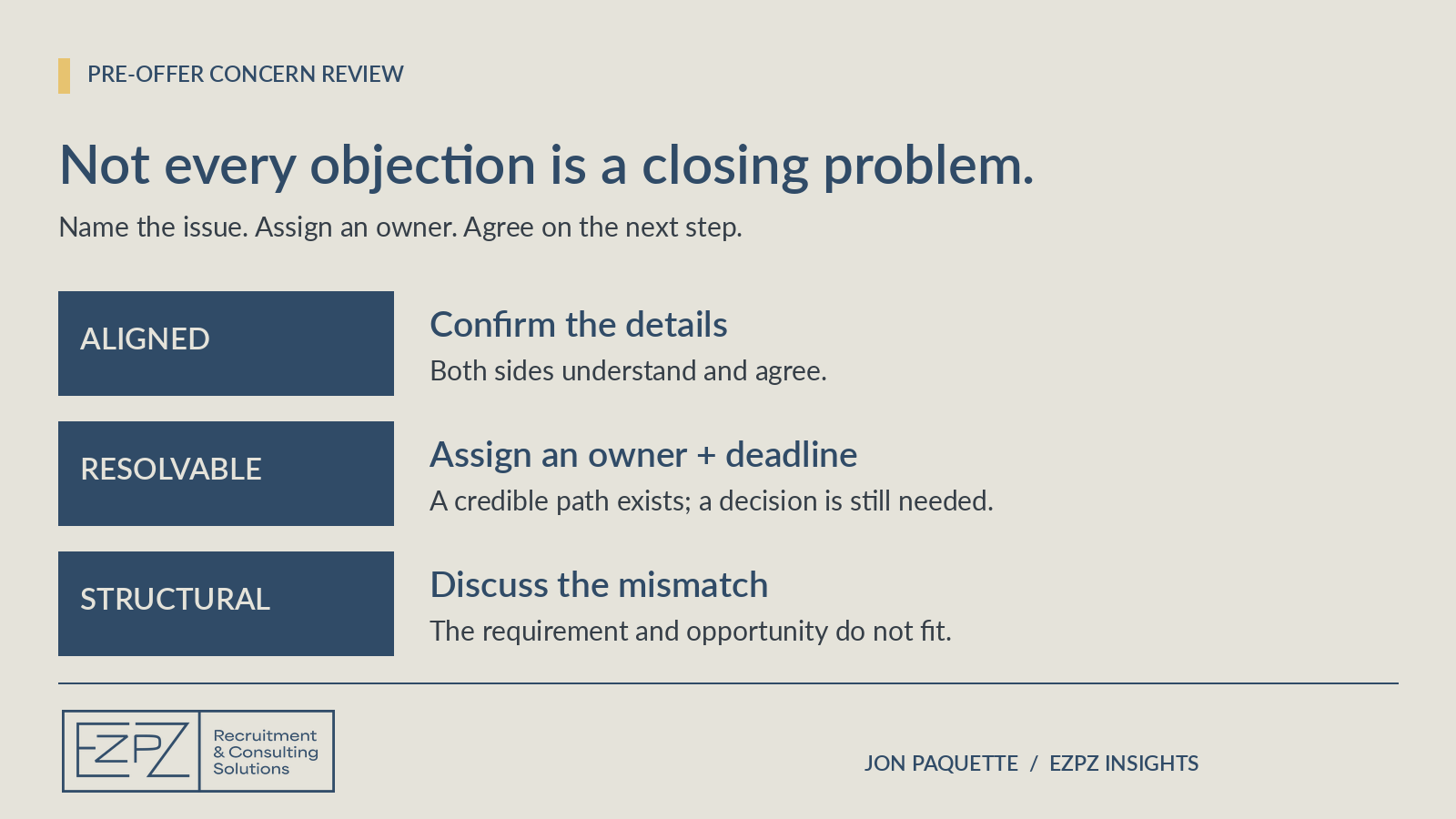
My preferred pre-offer review places each material concern in one of three categories:
- Aligned: Both sides understand the issue and agree on the relevant terms. Confirm the details rather than reopening the negotiation without a reason.
- Resolvable: There is a credible path to agreement, but a decision or conversation is still needed. Assign an owner and a deadline.
- Structural: The candidate’s requirement and the employer’s actual offer do not fit. Discuss the mismatch directly instead of relying on pressure to make it disappear.
A firm remote-work requirement and a role that genuinely requires full-time onsite work are not automatically a negotiation opportunity. Unless one side can and wants to change its position, the gap is structural.
By contrast, an unanswered question about decision authority might be resolved by a focused conversation with the hiring manager. An uncertain start date might be resolved through agreement on notice and onboarding needs.
This is where a recruitment partner adds practical value inside the client organization. The manager, HR team, finance approver, and other decision-makers may each own a different piece. My responsibility is to help surface the dependencies and keep the candidate informed, not to promise exceptions on their behalf.
Keep discovery active through every interview
The pre-offer review should bring together what we have learned, not introduce these questions for the first time. I treat closing as a continuous discovery process from initial qualification onward.
At the start, I establish the reasons for change, must-haves, nonstarters, target package, work-model requirements, and relevant timing. I record the candidate’s own language so later conversations can test whether the opportunity still meets those priorities.
After each interview, I ask what increased interest, what reduced it, and what remains unclear. I also check whether anything changed in the candidate’s other processes or in the role as the client described it.
The update to the hiring manager should include the material issue and a proposed next step. “They liked the team but still do not understand how project priorities are set” is more useful than “Good feedback.”
At the final stage, I confirm the likely role, reporting relationship, package, work model, start timing, and unresolved blockers. Conditional alignment is the objective, not a blind commitment before the candidate has seen the actual offer.
This approach also creates space for the client to reconsider. If the interviews reveal a different scope than the original brief, the team should resolve that discrepancy rather than expect the candidate to discover it after starting.
Discovery is not finished simply because the employer has decided who it wants.
Present the offer as a commitment from both sides
I want the hiring manager visibly involved when the offer is made. The candidate is choosing a future working relationship, not just the recruiter who coordinated the process.
The manager can explain why the person was selected, what the team needs them to accomplish, and why their contribution matters. I can then walk through the complete package, invite questions, and coordinate any negotiation within the client’s approved boundaries.
Material terms should be clear. Distinguish guaranteed compensation from contingent incentives, confirmed arrangements from possibilities, and an approved commitment from something that still requires review.
If the offer differs from the prior discussion, acknowledge the difference directly. Do not rely on the candidate’s excitement to carry them past a change they have not fully understood.
Decision timing should be fair and grounded in actual business needs or competing deadlines. I can advocate for prompt decisions without manufacturing urgency, hiding alternatives, or treating a reasonable question as disloyalty.
The strongest outcome is not a fast yes obtained by narrowing the candidate’s room to think. It is a clear decision reached with the information needed to make it responsibly.
Stay involved between acceptance and the start
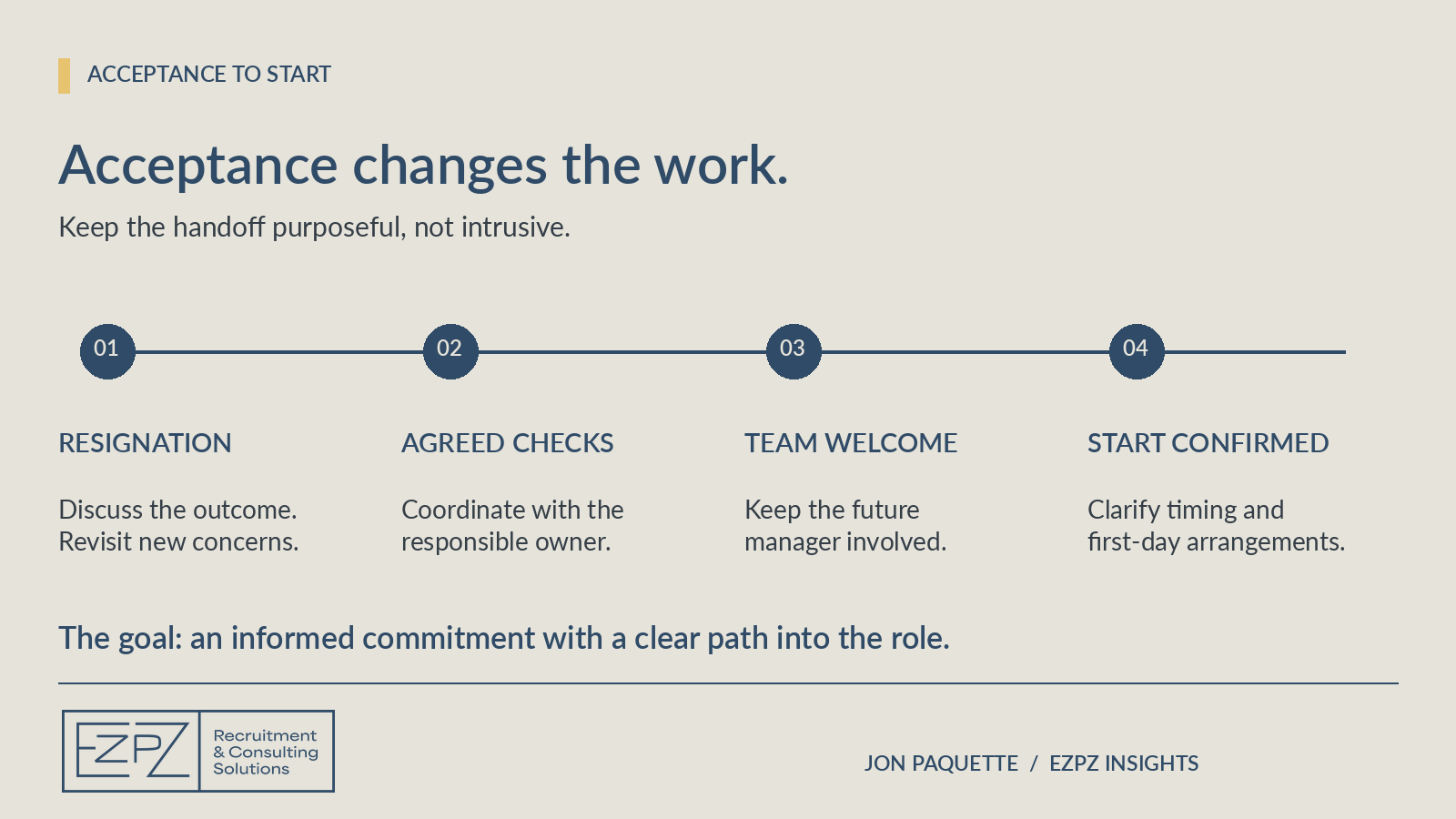
An acceptance changes the work; it does not eliminate it. Resignation, notice, agreed contingencies, and onboarding still need attention.
My focus is purposeful contact. Confirm the resignation outcome, check whether a counteroffer has introduced new questions, coordinate agreed start-date details, and keep the hiring manager engaged in the welcome and handoff.
For background checks or other employment conditions, the responsible employer or specialist should explain the requirements and manage its process. A recruiter should not promise clearance, give legal advice about restrictions, or advise a candidate to ignore unresolved obligations.
Useful contact has a purpose: an update on onboarding, an introduction to the team, clarification of first-day arrangements, or an answer to a concern. It should not feel like surveillance or repeated demands to prove commitment.
I also want the employer to honor what made the opportunity attractive in the first place. The reporting line, work arrangement, priorities, and support discussed during hiring should carry through into the start, or changes should be explained candidly.
The relationship the candidate is entering belongs to the manager and organization. A recruitment partner helps that transition happen with clarity rather than letting the offer letter become the last meaningful conversation.
Winning the hire means earning an informed commitment
A recruitment partner should be able to do more than ask whether a candidate will accept. The more useful questions are what must be true for them to accept confidently, what is not yet resolved, and whether the client can honestly meet those conditions.
For me, that means acting as a diagnostician, translator, and coordinator throughout the process. It means telling the client when its proposition is not aligned with the candidate’s needs, and telling the candidate when an attractive number does not resolve a poor fit.
Some objections are fixable. Some are not. Distinguishing the two is part of the service, not evidence that the recruiter failed to sell hard enough.
At EZPZ, the standard I work toward is an informed acceptance supported by a workable package, a credible career case, and a clear path into the role. No recruiter can remove every risk or guarantee what happens after a hire, but we can refuse to leave important questions unanswered simply because the interviews went well.
Closing starts before the offer because trust, understanding, and commitment need to be built before the decision is placed in front of someone.
If your hiring team needs help bringing that clarity to a technical or leadership search, explore EZPZ’s Recruitment & Talent Acquisition services or request a consultation at Info@EZPZ-Recruitment.com.